
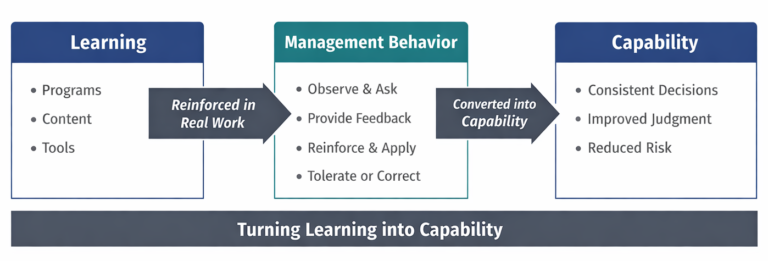
There is a quiet but persistent tension at the heart of modern corporate learning.
On one side, organizations have never been better equipped to deliver training at scale. Learning platforms are more
Corporate learning has inherited the language of software. We talk about scaling, deployment, adoption, and optimization. We assume that if learning can be distributed efficiently, it will also be absorbed and applied consistently.
That assumption is flawed.
You can scale content. You can scale access. You can scale reporting.
You cannot scale judgment, reinforcement, or context in the same way.
Those are human processes. They are shaped by everyday decisions, social dynamics, and leadership cues. They live in the messy, untracked spaces between formal systems.
This is why organizations with robust learning ecosystems can still feel fragile. They have infrastructure, but they lack embedded capability.
Most learning initiatives do not fail because the content was poor. In many cases, the material is thoughtfully designed, relevant, and aligned to real needs.
The failure happens afterward.
After the course ends, the organization quietly returns to its default operating mode. Priorities shift back to delivery. Managers are busy. Feedback is deferred. Old habits feel safer under pressure.
No one explicitly says, “The learning doesn’t matter anymore.”
But the system behaves as if it doesn’t.
Learning decays not because people are resistant, but because reinforcement is absent.
Completion rates are seductive because they are simple and reassuring. They give leadership teams a sense of progress and control. A 95% or 96% completion rate feels like success.
But completion metrics answer only one question: Did people finish the course?
They do not answer the questions boards and executive teams actually care about:
Are decisions becoming more consistent across teams?
Is risk being identified earlier and handled more effectively?
Are managers developing judgment, not just following instructions?
Is the organization becoming more resilient as it grows?
When completion metrics are treated as proof of impact, organizations unintentionally confuse activity with capability.
This is not a reporting flaw. It is a strategic blind spot.
Most learning succeeds or fails in moments managers control.
Not in training sessions.
Not in dashboards.
But in day-to-day interactions.
Managers decide what gets attention. They decide what gets reinforced. They decide what gets corrected, delayed, or quietly tolerated.
Every one-to-one, team meeting, and project review sends a signal about what actually matters. Those signals shape behavior far more powerfully than any course.
This is why managers are not just participants in learning systems. They are the system learning flows through.
When managers actively reinforce learning, capability compounds. When they do not, even the best-designed programs lose traction.
Organizations often respond to this insight by trying to turn managers into trainers or coaches with all the answers. That approach rarely works.
Managers do not need to master the content.
They do not need to reteach frameworks.
They do not need to become learning professionals.
What they need to do is much simpler—and much harder.
They need to become learning multipliers.
A learning multiplier does not explain everything. Instead, they ask better questions. They create space to practice. They notice progress. They make learning visible in real work.
Most importantly, they translate learning into context.
They answer the question every employee is silently asking:
“What does this mean for how we work here?”
Real learning shows up in places that rarely appear on dashboards.
It shows up in a ten-minute huddle where a manager walks through a real decision and explains the trade-offs involved.
It shows up in a one-to-one where feedback is given while the experience is still fresh.
It shows up when a leader pauses a meeting and reframes an outcome as a learning moment rather than a failure.
These moments are unglamorous. They are hard to standardize. They are difficult to measure precisely.
They are also where capability is built.
Organizations that successfully convert learning into capability do not add more training. They redesign how learning interacts with daily work.
They focus on a few practical shifts.
First, they define learning outcomes in behavioral terms. Instead of stating that employees should “understand” a concept, they identify one observable behavior that should show up consistently. If a behavior cannot be observed, it cannot be reinforced.
Second, they embed learning into existing operational rhythms. Learning survives when it is woven into one-to-ones, team meetings, and project retrospectives. It dies when it requires additional meetings or special effort.
Third, they shift manager expectations—sometimes subtly, sometimes explicitly. Managers are not evaluated solely on output. They are also expected to build capability within their teams. Even a small signal change in what leaders value can reshape behavior quickly.
Fourth, they track reinforcement rather than just completion. Instead of asking who finished the course, they ask where learning was discussed, practiced, or applied. This provides a far more accurate signal of organizational maturity.
From a board perspective, learning is not an HR initiative. It is a risk and scalability issue.
Boards care about whether an organization can grow without becoming brittle. They care about whether decision quality holds as complexity increases. They care about whether judgment is distributed or concentrated in a few individuals.
None of those outcomes are driven by course completion.
They are driven by how consistently managers reinforce learning in real work.
When learning becomes operational, organizations become more predictable, more resilient, and less dependent on heroics. That is what boards mean when they talk about maturity.
Learning does not scale horizontally through more content. It scales vertically through management behavior.
Every time a manager chooses to reinforce learning in the flow of work, capability strengthens. Every time they choose speed over reflection, learning weakens.
These choices happen every day, often unconsciously.
The role of leadership is not to eliminate this tension, but to design systems that make reinforcement easier than neglect.
The strategic question for organizations is not, “How do we deploy more learning?”
It is, “How do we design environments where learning survives contact with real work?”
Because learning is not something organizations do once or twice a year. It is something organizations become—through thousands of small, repeated managerial choices.
Learning platforms matter. Content matters. Systems matter.
But management behavior matters more.
That is where learning either compounds into capability—or quietly disappears.
About the author:
Hana Dhanji is the Founder & CEO of Cognitrex, an enterprise LearningOS platform and content design firm that helps organizations modernize learning and development.
Cognitrex works with enterprise teams to design and deliver role-based learning programs, onboarding pathways, and scalable training systems that improve workforce capability and performance. The platform combines LMS, LXP, and content infrastructure into a single system, paired with high-quality, scenario-based course design.
Hana is a former corporate lawyer at Sullivan & Cromwell and Hogan Lovells, having worked across New York, London, Dubai, and Toronto. She now advises organizations on how to move beyond fragmented training toward structured, high-impact learning systems.
She also serves as Treasurer and Chair of the Finance Committee for the UTS Alumni Association Board and as a Committee Member of the Ismaili Economic Planning Board for Toronto.
Learn more: