
Across regulated industries, leaders have long relied on a familiar signal of workforce readiness: training completion rates.
Compliance dashboards show high percentages. Employees have completed their annual training. Certifications are recorded in the learning management system.
From a governance perspective, the organization appears prepared.
But in recent years, a growing number of executives in sectors such as healthcare, financial services, utilities, aviation, and energy have begun to recognize a deeper structural flaw in this model:
Employees may finish training modules without acquiring the judgment, decision-making ability, or applied skills required to perform their roles effectively.
In environments where operational errors can lead to financial loss, safety incidents, regulatory sanctions, or reputational damage, the difference between training and competence becomes critical.
This realization is driving a major shift in how organizations design workforce learning systems. Instead of focusing on course libraries and training catalogs, companies are beginning to build learning infrastructure around two foundational ideas:
Competency mapping
Role-based learning pathways
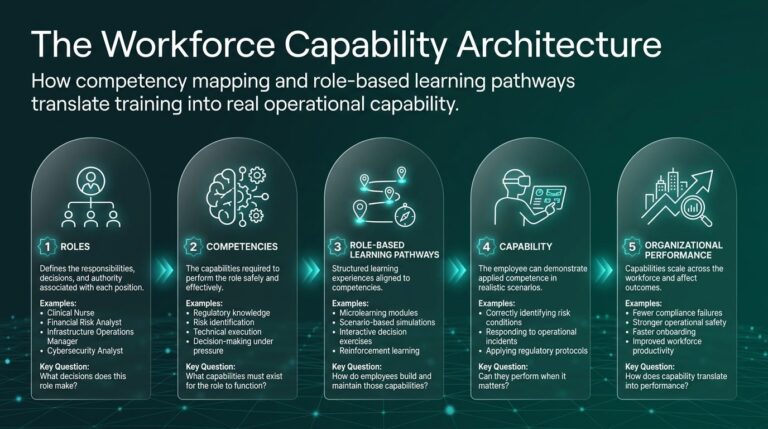
Together, these approaches represent a new architecture for workforce capability—one that aligns training directly with operational responsibilities and regulatory expectations.
Learning management systems (LMS platforms) emerged primarily as tools for assigning courses and tracking completion. Over time, organizations built vast libraries of compliance modules, policy trainings, and professional development courses.
This approach created a simple governance structure: if employees completed the required courses, the organization could demonstrate that training obligations had been fulfilled.
But this structure has increasingly produced what might be called the compliance illusion.
Training completion becomes a proxy for capability.
In reality, the relationship between the two is often weak.
Employees may:
skim through course content
click through modules without engagement
memorize answers to quizzes without understanding the underlying concepts
The organization records successful completion, but the underlying capability gap remains.
This problem becomes particularly acute in regulated industries, where operational competence—not merely knowledge—is essential.
A nurse administering medication, a financial analyst reviewing transactions, or an infrastructure operator managing system failures must exercise real-world judgment.
Training completion alone cannot ensure that judgment exists.
Instead of starting with training content, organizations begin with the structure of work itself.
The key question becomes:
What capabilities are required for each role within the organization?
Competency frameworks break roles into defined skill domains, which may include:
technical knowledge
operational procedures
regulatory requirements
decision-making capabilities
behavioral competencies
Each competency is then mapped to observable behaviors or tasks associated with the role.
For example, a competency framework for a healthcare role might include capabilities such as:
interpreting clinical protocols
identifying patient safety risks
communicating effectively in high-pressure environments
In financial services, competencies might include:
identifying suspicious transaction patterns
understanding regulatory reporting requirements
exercising ethical judgment in complex situations
By defining these competencies explicitly, organizations create a clear blueprint for workforce capability.
Training can then be designed to develop these competencies rather than simply deliver information.
Role-based learning pathways provide the mechanism for building capability.
Instead of assigning employees a collection of unrelated courses, role-based pathways guide them through structured sequences designed around their specific job responsibilities.
A typical pathway may include:
Foundational knowledge modules
Core regulatory requirements, policies, or technical concepts.
Applied learning experiences
Interactive simulations or case-based exercises.
Practice and reinforcement
Microlearning modules or scenario-based decision exercises.
Assessment tied to operational tasks
Evaluations designed to measure applied competence.
The goal is not simply exposure to information but progressive capability development.
Employees move through learning experiences that mirror the tasks and decisions they will encounter in their roles.
In this sense, role-based pathways function less like training programs and more like professional development systems embedded within the organization.
Three forces are driving this shift.
Financial regulators, for example, have emphasized the importance of conduct risk and cultural accountability.
Healthcare regulators are similarly focused on clinical competence and patient safety outcomes.
These expectations place pressure on organizations to move beyond basic training documentation.
A single compliance oversight may trigger regulatory investigations. A technical error may cause system failures or safety incidents.
Organizations are therefore investing more heavily in systems that ensure workforce capability.
Automation, artificial intelligence, and digital platforms are altering the tasks employees perform.
Static training programs cannot keep pace with these changes.
Competency mapping allows organizations to update capability frameworks as roles evolve.
Traditional training focuses primarily on knowledge transfer.
Employees read policy documents, watch instructional videos, or complete quizzes designed to test recall.
But expertise rarely emerges from knowledge alone.
It emerges from experience and decision-making under realistic conditions.
Scenario-based learning recreates those conditions.
Employees are placed inside simulated situations that resemble real operational challenges.
Examples might include:
identifying compliance risks in a financial transaction
responding to a patient safety incident in a hospital
managing a cybersecurity threat within an IT system
Participants must evaluate information, make decisions, and observe the consequences of those decisions.
Over time, these exercises develop the cognitive patterns associated with expert judgment.
Instead of memorizing rules, employees learn how to apply them.
Historically, LMS platforms functioned primarily as administrative tools.
Their purpose was to manage course assignments and track completion.
But capability-based learning architectures create new possibilities.
When roles, competencies, learning pathways, and assessment data are integrated, the learning system becomes a capability infrastructure layer within the organization.
Leaders gain visibility into questions that were previously difficult to answer:
Where do capability gaps exist across the workforce?
Which roles carry the highest operational risk?
How effectively are training programs improving performance?
In this sense, learning systems begin to resemble organizational control systems.
They help leaders understand and manage the human capabilities that underpin operational performance.
Historically, L&D departments have often been viewed as service functions responsible for delivering training programs.
Capability-based learning architectures elevate learning into a strategic discipline.
When workforce capability is linked directly to risk management, operational performance, and organizational resilience, learning becomes a core element of enterprise strategy.
Learning leaders increasingly collaborate with:
risk and compliance teams
operational leadership
human resources
executive management
Together, these groups define the capabilities required for organizational success.
Learning becomes an instrument for building those capabilities systematically.
Start with roles, not courses.
Define the responsibilities and decisions associated with each role.
Map competencies clearly.
Explicit capability frameworks create the foundation for structured learning pathways.
Focus on applied learning.
Scenario-based exercises develop operational judgment.
Use learning data strategically.
Analytics can reveal skill gaps and guide workforce investments.
Integrate learning with governance.
Capability systems should align with risk management and compliance structures.
That model is beginning to reach its limits.
In environments where human decisions shape operational outcomes, organizations must move beyond the assumption that training completion equals capability.
Competency mapping and role-based learning pathways offer a more rigorous approach.
They treat workforce capability as an organizational system rather than a collection of courses.
And in regulated industries, where the cost of capability failures can be severe, this shift may prove essential.
Because ultimately, completion is not competence.
And organizations that recognize the difference will be better positioned to build resilient, capable workforces for the future.
About the author:
Hana Dhanji is the Founder & CEO of Cognitrex, an enterprise LearningOS platform and content design firm that helps organizations modernize learning and development.
Cognitrex works with enterprise teams to design and deliver role-based learning programs, onboarding pathways, and scalable training systems that improve workforce capability and performance. The platform combines LMS, LXP, and content infrastructure into a single system, paired with high-quality, scenario-based course design.
Hana is a former corporate lawyer at Sullivan & Cromwell and Hogan Lovells, having worked across New York, London, Dubai, and Toronto. She now advises organizations on how to move beyond fragmented training toward structured, high-impact learning systems.
She also serves as Treasurer and Chair of the Finance Committee for the UTS Alumni Association Board and as a Committee Member of the Ismaili Economic Planning Board for Toronto.
Learn more: