
Customized skill development for exceptional customer interactions.
Customer-facing businesses meet familiar problems.
Industry-wide demand for skilled customer service reps leads to frequent turnover and a big increase in recruiting, training, and onboarding expenses.
Variations in training quality across locations can result in an uneven customer experience, decreasing customer satisfaction and lower repeat purchase sales.
Gauging the actual impact of customer training programs is complex, which makes it difficult to scale initiatives.
A lack of opportunities for professional development can quickly lead to disengagement and demotivation.
Gauging the actual impact of customer training programs is complex, which makes it difficult to scale initiatives.
Changing customer preferences and new communication tools make it difficult to maintain relevant training programs and it's leaving customer service reps unprepared.
Learning Platform
Deliver continuous customer service training.
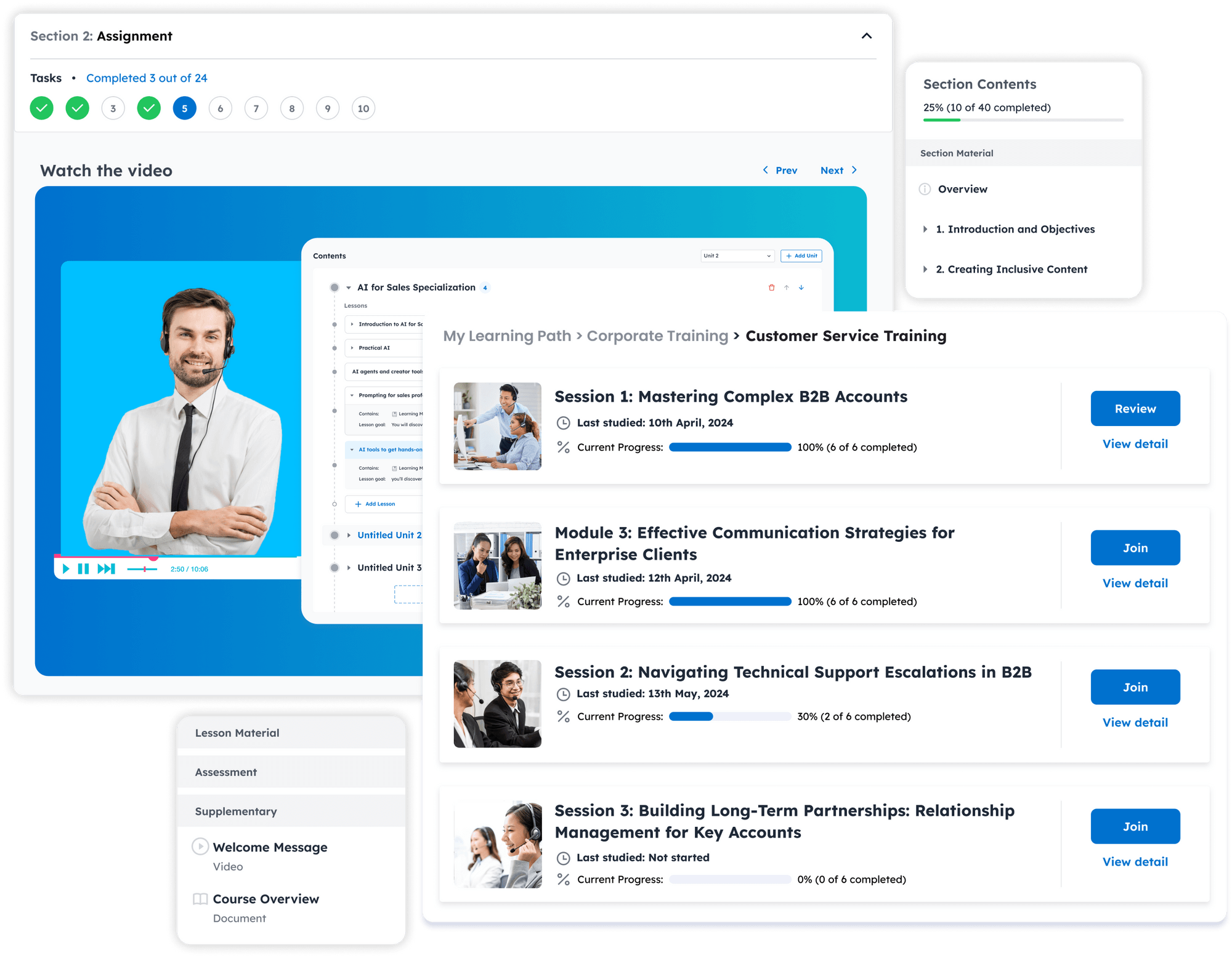
We actively teach skills that transform client experiences.
Beyond traditional eLearning. We integrate interactive courses with live, instructor-led training sessions and tailored self-study.
Reinforce knowledge through practical role-playing. Master soft skills like empathy, negotiation, and conflict resolution.
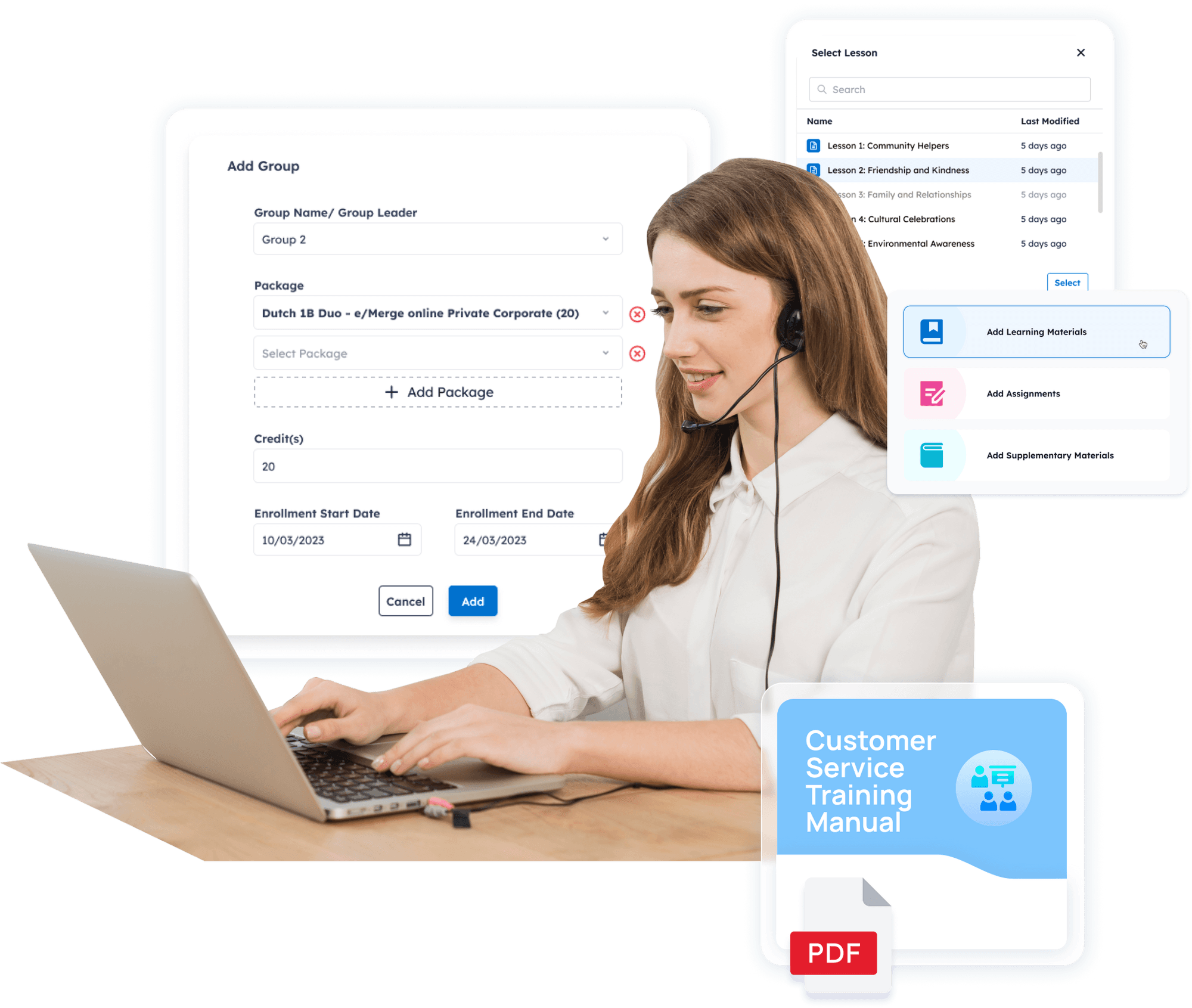
Partner with our instructional design experts to create a customized curriculum covering all your products, services, and processes.
Build a knowledge base by uploading product guides, templates, and troubleshooting manuals with our content repository.
Tailored Service
A proven way to get results.
Our learning specialists partner with your customer service reps guaranteeing all content is skills-based and results focused.
We empower customer service teams to routinely practice new skills, transforming knowledge into role-specific capabilities.
We reduce turnover costs, boost revenue, and align skills with performance - ensuring training is impactful and measurable.
Our hybrid training solution is built for scale and far more cost-effective than traditional in-person training.

Yes, hybrid learning is adaptable for organizations of all sizes. It is particularly effective for B2B customer service training, allowing companies to combine digital learning modules for product knowledge with instructor-led practice delivered internally or through third-party providers. Smaller organizations benefit from cost-effective, flexible training delivery, while larger enterprises can ensure consistency across diverse teams managing complex B2B accounts.
Hybrid learning supported by an LMS is highly cost-effective for B2B customer service training. Initial investments are offset by reduced travel costs, minimized time away from customer-facing responsibilities, and reusable digital learning content. For B2B environments, this approach enables rapid updates to product and service knowledge, ensuring teams stay current and consistent. Instructor-led components, when required, are delivered internally by the organization or through third-party providers. ROI is typically realized within the first year and can be calculated as:
ROI (%) = (Benefit − Cost) / Cost × 100
Our program combines digital learning modules for product knowledge and industry trends with instructor-led skill development delivered internally by organizations or through third-party providers. This blended approach improves engagement and knowledge retention, which is critical for managing complex B2B client relationships. LearningOS analytics help identify areas where customer service representatives may need additional support, enabling continuous improvement in client interactions and performance.
To measure the effectiveness and ROI of a B2B customer service hybrid learning program, organizations should focus on key performance indicators tied directly to business outcomes. These include training completion rates, improvements in customer satisfaction scores, and reductions in escalation rates. Additional metrics such as increases in successful upsells or cross-sells and reduced time-to-proficiency for new representatives help assess performance impact. Program ROI can be calculated by comparing total program costs against gains in client retention, contract renewals, and service expansion. LearningOS supports this evaluation through analytics aligned with Kirkpatrick’s model, enabling organizations to assess learner reaction, knowledge acquisition, behavior change, and measurable business results. This approach provides a clear, data-driven view of training effectiveness and its impact on workforce capability and bottom-line performance.
With a faster and more effective way to train.