Why Compliance Training Does Not Build Competency in Regulated Organizations
Published by: Lou Besonia | April 27, 2026
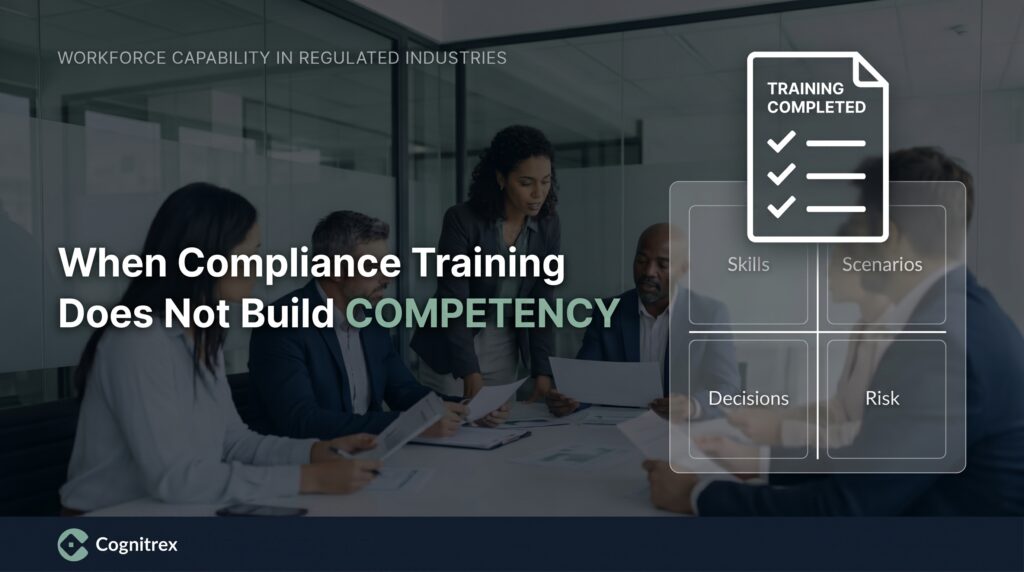
Compliance training satisfies regulatory checklists by documenting that employees completed assigned modules. Competency-based learning validates that employees can demonstrate specific skills to a defined standard under realistic conditions. For regulated organizations across healthcare, financial services, pharmaceuticals, oil and gas, and telecommunications, the distinction determines whether your training program produces audit-ready evidence of workforce capability or just completion certificates that regulators do not accept as proof of competency.
Regulated organizations spend millions annually on compliance training programs that do not build the competencies those programs claim to address. The training gets completed. The certificates get filed. The audit happens. The regulator asks for evidence that employees can perform the functions their roles require. The organization produces completion records. The regulator writes the finding.
The gap is not a training delivery problem. It is an architecture problem. Compliance training was designed to document the event of training, not validate the outcome. Competency-based learning was designed to produce evidence of demonstrated capability. These are not the same thing, and treating them as interchangeable is the reason most regulated organizations discover their training program does not meet regulatory requirements only after the inspection report is written.
What Compliance Training Actually Does
Compliance training ensures that employees are exposed to required content within a defined timeframe. It documents that the training was assigned, accessed, and marked complete. It produces reporting that shows who completed what and when.
In regulatory terms, compliance training satisfies the procedural requirement that training occurred. It does not satisfy the substantive requirement that the training produced the capability it was designed to build.
A healthcare worker who completes a patient safety module has satisfied the compliance training requirement. Whether that worker can identify a safety risk in a live clinical scenario and execute the correct response protocol is a separate question. The completion record does not answer it.
A financial services employee who completes an anti-money-laundering module has satisfied the compliance training requirement. Whether that employee can recognize a suspicious transaction pattern and follow the reporting procedure under time pressure is a separate question. The completion certificate does not answer it.
A pharmaceutical technician who completes a Good Manufacturing Practices module has satisfied the compliance training requirement. Whether that technician can execute a procedure without deviation when the process conditions change is a separate question. The training log does not answer it.
An oil and gas operator who completes a confined space safety module has satisfied the compliance training requirement. Whether that operator can assess hazard conditions and apply the correct safety protocol in the field is a separate question. The course certificate does not answer it.
Compliance training produces evidence that training happened. It does not produce evidence that competency was built.
What Competency Requires
Competency is not knowledge. It is the demonstrated ability to apply knowledge under the conditions in which the skill will be used on the job.
In regulatory terms, competency requires three elements that compliance training does not address:
Assessment of starting capability. Competency-based learning begins with diagnostic assessment that establishes what the employee can already do before training is assigned. This prevents redundant training and identifies specific gaps at the individual level. Compliance training assigns the same module to all employees regardless of current capability.
Realistic performance conditions. Competency-based learning uses scenario-based assessment that simulates the job conditions under which the skill must be performed. This includes time pressure, ambiguous information, competing priorities, and the decision-making context the employee will face in practice. Compliance training uses multiple-choice knowledge checks that do not replicate job conditions.
Evidence of demonstrated performance. Competency-based learning captures structured evidence that the employee performed the skill to a defined standard. The evidence is auditable, attributable to a specific individual, and tied to the competency framework the organization operates under. Compliance training captures completion status, not performance evidence.
Regulators across industries require all three elements. Compliance training provides none of them.
Why Organizations Confuse the Two
The confusion is structural, not incidental.
Most regulated organizations procured their learning management system to satisfy compliance documentation requirements. The platform was selected for its ability to assign training, track completions, and produce compliance reports. It was not selected for its ability to validate competency.
Over time, the platform became the definition of what training means in the organization. If the platform tracks completions, the organization measures completions. If the platform does not capture competency evidence, the organization does not ask for it.
The procurement logic reinforces the gap. When a new regulatory requirement appears, the compliance team asks: what training do we need to assign? The correct question is: what competency do we need to validate? The first question leads to another compliance module. The second question leads to competency-based learning design.
The result is a training program built entirely around content delivery and completion tracking, with no mechanism to validate whether the training produced the capability it was designed to build. The organization believes it is meeting regulatory requirements because the completion rates are high. The regulator believes otherwise because the evidence of workforce competency does not exist.
This gap does not surface until the audit. By then, the cost of remediation is significantly higher than the cost of building the program correctly from the start.
The Cost of the Confusion
The cost is not the compliance training budget itself. The cost is the operational risk, regulatory exposure, and workforce performance gap that persists after the training is complete.
Regulatory findings. When a regulator inspects a facility, interviews employees, or reviews workforce records, the question is not “did this employee complete training?” The question is “can this employee perform this function to the required standard?” Completion records do not answer the second question. Organizations that cannot produce competency evidence receive findings, corrective action plans, and in high-risk industries, operational restrictions until the gap is closed.
Deployment risk. Healthcare organizations that cannot verify clinical competency before deployment expose patients to risk and the organization to liability. Financial services firms that cannot verify client-facing competency expose the firm to compliance failures and reputational damage. Pharmaceutical manufacturers that cannot verify operator competency expose production to quality deviations and batch failures. Oil and gas operators that cannot verify field competency expose workers to safety incidents and the operation to regulatory penalties.
Training inefficiency. Compliance training assigns the same module to all employees regardless of current capability. This wastes the time of employees who already possess the competency and fails to close the gap for employees who do not. Competency-based learning directs training resources to the specific gaps identified through diagnostic assessment. The result is faster time-to-competency and lower total training cost per competent employee.
Accreditation delays. Healthcare organizations, financial services firms, and other accredited entities that cannot produce competency evidence face delayed renewals, conditional accreditation status, or loss of accreditation entirely. The remediation timeline is measured in months, not weeks, because building a competency validation system after the fact requires redesigning the entire training architecture.
The longer the confusion persists, the higher the cost. Organizations that wait until the regulatory finding to address the gap pay significantly more than organizations that build competency validation into the training program from the start.
What Competency-Based Learning Looks Like
Competency-based learning is not a module type. It is a training architecture designed to validate demonstrated performance rather than content consumption.
In practice, competency-based learning incorporates the following elements:
Competency frameworks aligned to regulatory standards. The organization defines the specific competencies each role requires, mapped to the regulatory framework or accreditation standard the organization operates under. This ensures that the competencies being validated are the competencies the regulator will inspect.
Diagnostic assessment before training. Each employee is assessed against the competency framework to establish current capability. Employees who already demonstrate the competency are not assigned redundant training. Employees with gaps are routed to targeted learning interventions.
Scenario-based learning and assessment. Training content incorporates realistic scenarios that replicate the job conditions under which the competency must be performed. Assessment measures whether the employee can execute the skill under those conditions, not whether the employee can recall information in a multiple-choice quiz.
Evidence capture and audit trail. The system records structured evidence of demonstrated performance for each competency. The evidence includes the assessment scenario, the employee’s response, the evaluator’s judgment (if human-evaluated), and the timestamp. This evidence is what regulators accept during inspection.
Remediation routing. Employees who do not demonstrate the competency on first attempt are routed to targeted remediation and reassessed. The system tracks the number of attempts, the interventions applied, and the final outcome. This data informs training design improvements and identifies systemic competency gaps across the workforce.
Integration with workforce deployment systems. Competency records integrate with scheduling, credentialing, and deployment systems so that only employees who have demonstrated the required competencies are assigned to roles that require them. This closes the gap between training completion and operational deployment.
Competency-based learning costs more to design than compliance training because it requires scenario development, competency framework mapping, and evidence capture architecture. It costs less to operate because it eliminates redundant training, reduces deployment risk, and produces the evidence regulators require without remediation after the fact.
Organizations that build competency-based learning from the start avoid the cost of discovering the gap during an audit.
Learn more about the platform.
Frequently Asked Questions
What is the difference between compliance training and competency-based learning?
Compliance training documents that employees completed assigned modules within a required timeframe. Competency-based learning validates that employees can demonstrate specific skills to a defined standard under realistic job conditions. Compliance training produces completion records. Competency-based learning produces evidence of demonstrated performance. Regulators accept the second, not the first, as proof of workforce capability.
Why do regulators require competency evidence instead of completion records?
Regulatory frameworks across industries require organizations to demonstrate that their workforce can perform the functions their roles require, not just that training was assigned and completed. Completion records prove that training happened. They do not prove that the training built the capability it was designed to address. Competency evidence proves demonstrated performance to a defined standard, which is what regulators inspect for during audits, accreditation reviews, and facility inspections.
Can compliance training be converted into competency-based learning?
Not without redesign. Compliance training is built around content delivery and completion tracking. Competency-based learning is built around diagnostic assessment, scenario-based performance validation, and evidence capture. The architecture is fundamentally different. Organizations can add competency validation on top of existing compliance training by incorporating diagnostic assessment, scenario-based testing, and evidence capture into the program, but this requires new learning design, new assessment instruments, and in most cases, a platform upgrade.
What industries require competency-based learning instead of compliance training?
Any industry where workforce capability is subject to regulatory inspection, accreditation review, or compliance audit. This includes healthcare (accreditation bodies, provincial regulators), financial services (OSFI, securities regulators), pharmaceuticals (Good Manufacturing Practices inspections), oil and gas (safety certifications, contractor management), telecommunications (vendor compliance, cybersecurity certifications), and any other regulated sector where demonstrated competency is a regulatory requirement, not just a training completion checkbox.
How much does competency-based learning cost compared to compliance training?
Competency-based learning costs more to design because it requires competency framework development, scenario-based assessment creation, and evidence capture architecture. It costs less to operate because it eliminates redundant training for employees who already demonstrate the competency, reduces deployment risk by validating capability before assignment, and avoids the cost of regulatory findings and remediation after the fact. The total cost of ownership over a three-year period is lower for competency-based learning than for compliance training programs that fail inspection.
What happens if a regulated organization continues using compliance training instead of competency-based learning?
The organization will continue to produce completion records that regulators do not accept as evidence of workforce competency. During the next regulatory inspection, accreditation review, or compliance audit, the organization will be asked to produce evidence that employees can perform the functions their roles require. Completion certificates will not satisfy this request. The result is regulatory findings, corrective action plans, delayed accreditation renewals, or in high-risk industries, operational restrictions until competency evidence is produced. The cost of building a competency validation system after a finding is written is significantly higher than building it before the audit.
Can a learning management system (LMS) support competency-based learning?
Only if the LMS was designed with competency validation architecture. Most LMS platforms were built for content delivery and completion tracking, not competency evidence capture. A standard LMS can be upgraded to support competency-based learning by adding diagnostic assessment tools, scenario-based learning modules, and evidence capture functionality, but this requires either a platform replacement or a significant capability layer added to the existing system. Organizations evaluating an LMS for regulated industries should assess whether the platform produces competency evidence, not just completion reports.
How long does it take to transition from compliance training to competency-based learning?
The timeline depends on the size of the workforce, the number of competencies that need to be validated, and whether the organization is building on an existing compliance training program or replacing it entirely. For a mid-sized regulated organization, the transition typically requires 6-12 months to complete competency framework mapping, scenario development, assessment instrument design, platform configuration, pilot validation, and full rollout. Organizations that wait until after a regulatory finding to begin the transition face compressed timelines and higher implementation costs.